Brothers in Arms – Dire Straits (1985)
October 17, 2025
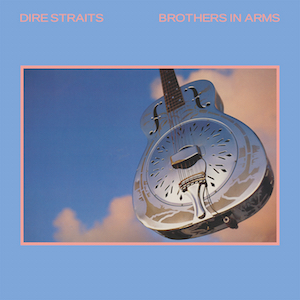
The original iteration of Dire Straits was formed by the Knopfler brothers – Mark and David – in the late 70s, when they would kick off their career with the release of their self-titled debut. Skyrocketing to #2 on the Billboard 200, the record would instantly make Dire Straits one of the biggest rock bands on the planet and mark the beginning of an excellent run. But unfortunately for poor David, who provided rhythm guitar and backing vocals for the band until 1980 – this was the Mark Knopfler show, and there was never going to be room for anyone else in any kind of significant way.
By the mid-80s, Dire Straits had compiled a discography of four very successful albums – all having reached the top 20 on the US pop chart – but none of their debut’s follow-ups had quite matched the heights of their initial success, and Knopfler was ready to take the band to an entirely different level. Having already written and rehearsed all of the tracks that would eventually become 1985’s Brothers in Arms, he brought in Neil Dorfsman – who had worked with a collection of some of the most well known musical artists on the planet, including KISS, Bruce Springsteen, Diana Ross, Bob Marley, Bob Dylan, Carly Simon, and Barbra Streisand – to co-produce the new record. And given that bassist John Illsley was the only remaining member of the original Dire Straits, Knopfler assembled a super team of studio musicians to back him up – tapping the Brecker Brothers for sax and trumpet, King Crimson’s Tony Levin for additional work on bass, and Sting for backing vocals on what would become the album’s mega-hit, “Money for Nothing.”
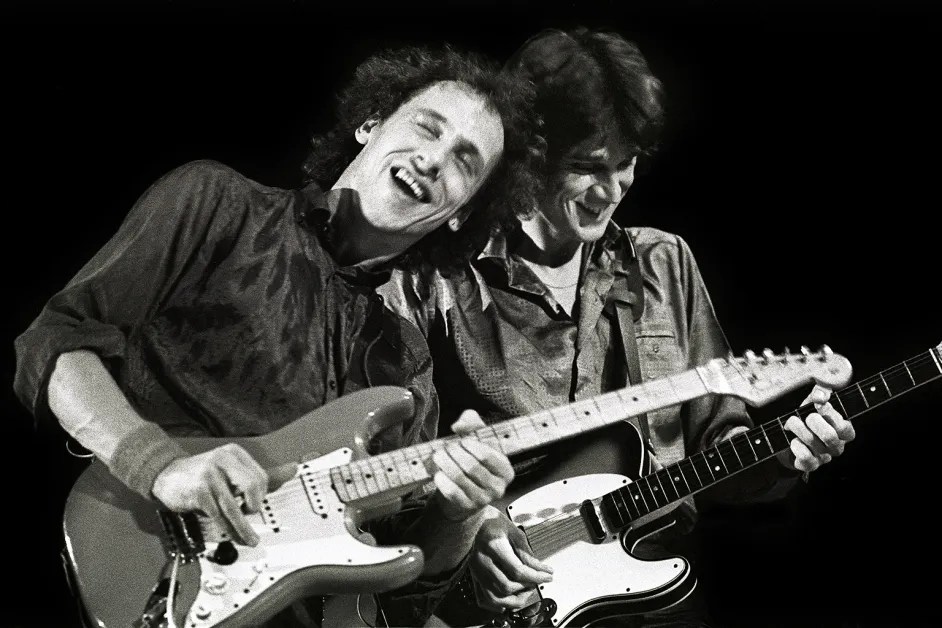
Mark and David Knopfler on stage in the late 70s
Brothers in Arms would not only go on to become Dire Straits’ first number one album, but it would also earn the distinction of being the first record to sell over a million copies in CD format, and to this day remains one of the best selling albums of all time – at over 30 million copies and counting. It would also feature three hit singles in the US – with “Money for Nothing” hitting #1, “Walk of Life” reaching #7, and “So Far Away” charting at #19. Their lead single also benefited from the fact that MTV was at the absolute peak of its popularity – resulting in heavy rotation for its music video, which featured early 3D computer animation to match its futuristic lyrics. But despite its soaring popularity and commercial success, the record got pretty dinged up by critics, who took offense to what they deemed as the sellout nature of the album and specifically the expensive, heavy-handed production work throughout.
Lyrically, the album is broken pretty clearly into two distinct thematic halves – with the A-side tracks focusing on the music industry and some of Knopfler’s legendary influences, while the B-side consists of songs about the futility and horror of war. “Money for Nothing” – which for better or for worse will always exist as Dire Straits’ signature song and lasting legacy – tells the true story of a guy working in an appliance store (see: “microwave ovens,” “custom kitchen deliveries,” “refrigerators,” “color TVs”), who complained to Knopfler about the cheesy nature of so much of the pop music that was being released in the mid-80s, and lamented over the fact that these artists were getting endless amounts of money and women for creating garbage. On top of Sting’s memorable delivery of the MTV slogan throughout the song, Knopfler takes aim at hair metal rockstars with the poorly-aged takedown of the “little f***** with the earring and the make-up” (rumored to be targeted at Vince Neil of Mötley Crüe), and his putdown of their talentless drummers “bangin’ on the bongos like a chimpanzee.” Knopfler also includes a litany of references to his favorite artists of the past – the protagonist of “Walk of Life” is a street performer who plays hits from guys like Chuck Berry and Ray Charles, and “Why Worry?” was written to sound like the Everly Brothers (who would go on to cover it years later). Meanwhile, the B-side’s military theme is expressed on “Across the River,” with several allusions to the proxy wars being carried out by the Reagan administration in Latin America; while “The Man’s Too Strong” shows a low-level soldier being forced to torture a POW; and the Falklands War-inspired title track digs into the brotherhood formed by the trauma of combat.

Mark Knopfler and Sting performing at Live Aid
I can’t make the argument that Brothers in Arms – which would end up being the last Dire Straits’ release until their forgettable final album, 1991’s On Every Street – is their greatest work (a distinction that indisputably should be awarded to their debut). But what I can say is that it is a truly exceptional album and the logical next-step in the progression in Knopfler’s career. Music critics at the time who torched the record were likely suffering from the same prisoner of the moment syndrome that resulted in ridiculous takes on hit albums like Bruce Springsteen’s Born in the USA, David Bowie’s Let’s Dance, and ZZ Top’s Eliminator – and retrospective reviews with more historical context have been much kinder. It’s hard to argue against Knopfler’s signature guitar sound, raspy vocal delivery, and culturally timely lyrics – making the release a true masterpiece. And the album’s crown jewel, “Money for Nothing,” lives on in the pantheon of songs whose lyrics and sound are perfect encapsulations of music in the 1980s. The irony of course, is that its thematic make-up would prove to be inadvertently self-referential in the eyes of many critics, who would write it off as cheesy and self-indulgent. But in my view, there’s no good argument against Brothers in Arms and there’s certainly no good argument against Dire Straits – one of the greatest works by one of the greatest bands of the entire era, and a shining monument to the unquestionable brilliance of Mark Knopfler.

 80 Albums of the 80s
Leave a comment