Let’s Dance – David Bowie (1983)
August 1, 2025
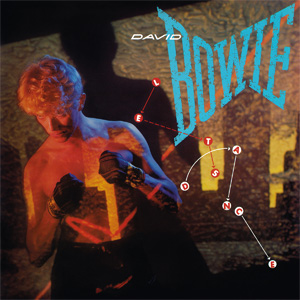
When I last wrote about David Bowie, he had pivoted toward making more commercial music with 1980’s Scary Monsters (and Super Creeps) – and succeeded in doing so, with the album reaching #1 in the UK and #12 in the US. In the two years that followed, Bowie would lend himself as a collaborator with Queen on the 1981 hit “Under Pressure,” as well as with Giorgio Moroder on the theme for Paul Schrader’s Cat People. But by 1983, he was ready to begin work on his next album and was even more keen than before on releasing a hit parade. So in a major shift, he made a change at producer – opting for Chic’s Nile Rodgers, who had produced hits not only as a member of his own band, but as a producer for the latest releases from Sister Sledge and Diana Ross. Longtime producer Tony Visconti – who had been collaborating with Bowie since 1977 – was understandably hurt by the decision and has since said that it severely damaged their relationship until they reunited in 2002 for Heathen.
Aside from the switch toward a more commercial producer, Let’s Dance marked another significant shift for Bowie, as it was the first time that he had played no instruments on an album and only provided vocals. Taking the lead on instrumentals instead were the members of Chic along with a young guitarist, who was still largely unknown at the time, named Stevie Ray Vaughn. Bowie also aimed to pivot even further away from the rock sounds that had comprised the majority of his 70s releases and more towards the new wave, post-disco, and dance rock feel of 1983’s music landscape – a shift that had begun with Scary Monsters three years prior.

Bowie with Stevie Ray Vaughn and Nile Rodgers
His gamble certainly paid off in terms of commercial success, as the album would reach #4 in the US, become his all-time best selling record, and include four hit singles – “Let’s Dance” (#1), “China Girl” (#10), “Modern Love” (#14), and “Without You” (#73). But his big wins on the charts came at a steep price, with many music critics and longtime fans alleging that this was a sellout record and feeling like it was beneath Bowie’s artistic standards. And despite defending the move at the time, Bowie would eventually admit years later that he believed this album and the others that would follow it in the 1980s were his “Phil Collins years” (which I personally view as a positive even though Bowie clearly did not).
Although Bowie was criticized on this record for regressing in terms of songwriting, there is undoubtedly some strong lyricism throughout Let’s Dance. Most striking to me is the recurring theme of forceful integration of one culture into another. “China Girl” is probably the most overt example, with lyrics that include “visions of swastikas” and promises (or threats) to provide “television,” “eyes of blue,” and “a man who wants to rule the world.” He continues to display the thematic imperialism in the music video for “Let’s Dance,” where Australian Aboriginals are shown integrating into white culture through music, fashion, shopping, and cuisine. But the one area where I feel Bowie doesn’t quite reach the high expectations that he had set for himself (and his audience) is the fact that nearly half of the album consists of covers and remakes. “China Girl” is a re-imagining of a song that he and Iggy Pop co-wrote for the latter’s 1977 album The Idiot, “Criminal World” is a cover of a song by Metro from 1977, and “Cat People (Putting Out Fire)” is an updated version of the track he made with Moroder for the film. And although his intentions were good on all three – he re-released “China Girl” to help Pop out financially, gave “Criminal World” new life after the original had been banned from the BBC for bisexual undertones, and wanted another crack at “Cat People (Putting Out Fire)” because he was dissatisfied with the original – I do feel like it further cheapens an album that was already going to take heat for its commercial sound.
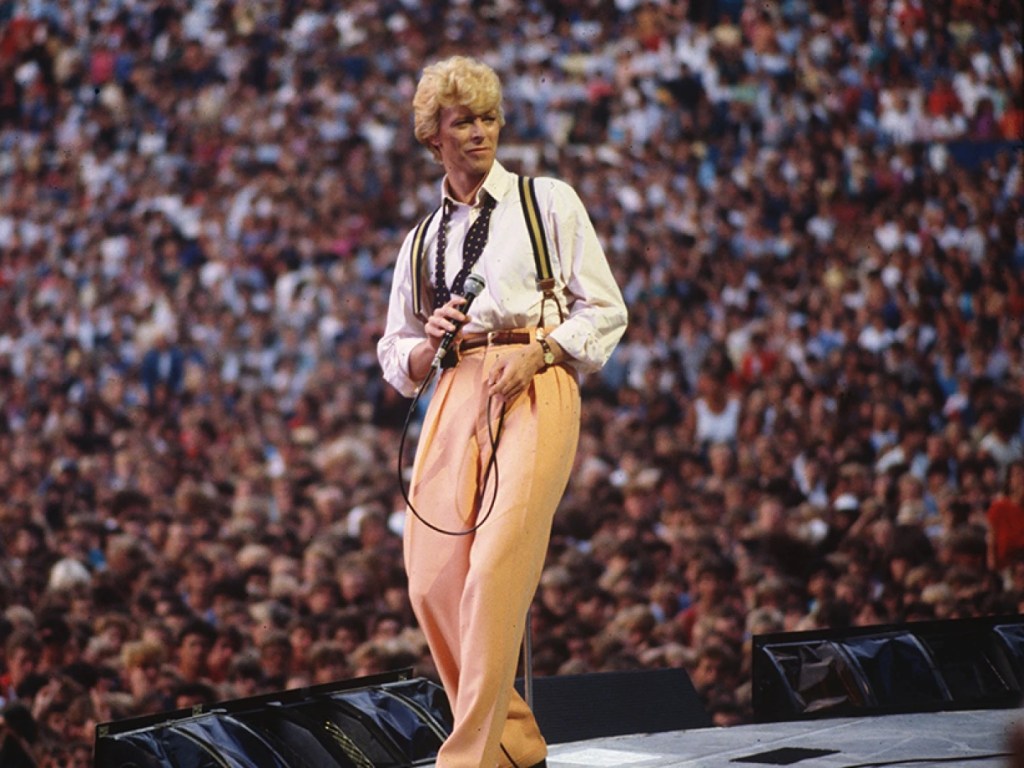
Bowie on stage during the Let’s Dance tour
To me, Let’s Dance is the last truly great Bowie album – regardless of the fact that its criticisms may have had some validity. Generally speaking, I have no issues with a musical artist gunning for commercial success, as ultimately the goal should be to have as many people listen to and enjoy your songs as possible. But I think the reason that critics, fans, and even Bowie himself were so hard on the album comes from the fact that he is truly one of the most unique, singular musicians of the twentieth century. Everything from his appearance to his personality to his music always felt like it was part of a bigger piece of performance art – showing the world a man who was never content with the status quo and pursued constant evolution and shape-shifting. But like with nearly everything – two things can be true. On one hand, yes, this album doesn’t feel quite as revolutionary and groundbreaking as many of the other Bowie releases. On the other hand, this record produced several of the most well-known and celebrated tracks of his entire discography. And the reality is that many of its harshest critics likely suffered from being prisoners of the moment who were susceptible to nostalgia and pop music fatigue. But the fact remains that this album – and especially its three mega hits – are undeniably among the most signature achievements of not only Bowie’s impeccable career, but the decade as a whole.

 80 Albums of the 80s
Leave a reply to Like a Virgin – Madonna (1984) – 80 Albums of the 80s Cancel reply