Big Science – Laurie Anderson (1982)
June 6, 2025

Throughout the 1970s, Laurie Anderson’s primary focus was often on incorporating musical elements to performance art rather than making music for music’s sake. A perfect example was her piece, Duets on Ice, during which she would play violin while in skates that had been frozen into a block of ice and conclude the performance once the ice had completely melted. Anderson was also a frequent collaborator with comedian Andy Kaufman and performed at the Nova Convention alongside other well-known artists like Frank Zappa, Allen Ginsberg, and Philip Glass. But as the decade progressed, she found herself more and more drawn to not just performing, but also the making of the music itself – contributing recordings to a handful of avant garde musical compilations by Giorno Poetry Systems, which featured poet John Giorno (who was a part of the Andy Warhol social orbit) and prolific postmodern author, William S. Burroughs.
But Anderson’s biggest career shift began while she was touring her magnum opus performance piece called United States, which was an hours-long live show that included musical numbers, spoken word pieces, and animated shorts about living in America. What Anderson – and frankly anyone else in the performance art world – didn’t expect was that one of the songs from United States would actually have commercial appeal. A DJ named John Peel got his hands on one of the 1,000 copies of her single, “O Superman” (which Anderson was selling and distributing out of her own apartment), and was so blown away by it that he would frequently play it on BBC Radio 1. The song quickly picked up steam and became so popular that it would actually go on to reach #2 on the U.K. singles chart, leading to Anderson being picked up by Warner Brothers for a seven-album deal. So Anderson’s debut record would be 1982’s Big Science, which featured “O Superman” along with a selection of other songs from her United States performance – all of which thematically focused on the often harmful role that technology and science play in our society. And despite the heady subject matter and experimental sound, the album would shockingly reach the Billboard 200 at #124.
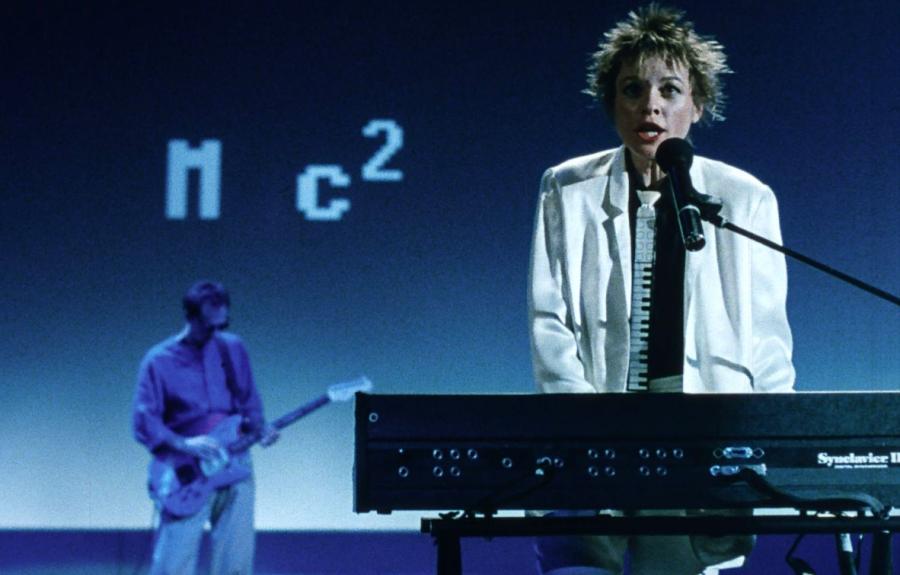
Anderson on stage
The record’s central theme is most evident on its hit single, on which Anderson targets what she would later call the “techno-humiliation” faced by the U.S. government during the botched rescue of the hostages being held in the American Embassy in Iran in 1980. During the failed attempt, the seemingly invincible American military saw their cargo plane and helicopter collide, leading to eight soldiers being killed and the mission being aborted. The constant lyrical parallel in the song is comparing the United States government to the narrator’s mother, most notably with the lyrics, “’Cause when love is gone, there’s always justice. And when justice is gone, there’s always force. And when force is gone, there’s always Mom.” She concludes the song with the particularly striking lyrics of, “So hold me, Mom, in your long arms, your petrochemical arms, your military arms, in your electronic arms.”
On top of “O Superman,” Anderson continues to reinforce the theme that technology (or big science) will not save you, and that despite the illusion of comfort and protection, we are all living with the threat of potential chaos. The album’s opening track, “From the Air,” is delivered from the perspective of the pilot of a plane that is about to crash, who calmly tells the passengers, “This is your Captain – and we are going down. We are all going down together.” Anderson continues her reinforcement of this striking theme on the title track, whose protagonist declares, “Big Science. Hallelujah. Big Science. Yodellayheehoo,” but also concedes “Every man, every man for himself. All in favor, say aye.” And on the album’s final song, “Let X=X/It Tango,” she gives her take on where she thinks our society is going when she plays on the beauty of the stars in the night sky by singing, “It’s a sky-blue sky. The satellites are out tonight.”

Anderson in her studio
If I had never heard Big Science, and someone tried to describe it to me, I would undoubtedly write it off as sounding pretentious. But what makes it such an accomplishment is not only its intellectually interesting ideas, but just how sonically captivating it is. It’s nearly impossible not to be drawn in by the sound of her spoken word lyrics atop strange synthetic sounds and instruments like bagpipes, marimbas, organs, and violins. It’s truly like nothing else I’ve ever listened to, and I would encourage anyone who hasn’t heard it to at least give one song a shot (with “From the Air” or “O Superman” being the best starting points). I can say that without a doubt, Laurie Anderson may be one of the most surprising musical artists to achieve even modest commercial success, and “O Superman” may just be the most shocking top 10 hit of all time. Big Science is simultaneously thematically prescient and profound, while also providing a musical beauty and legitimately enjoyable listening experience. It was a perfect album to encapsulate the zeitgeist of 1982, and is perhaps an even more perfect fit for our tech-obsessed society in 2025.


 80 Albums of the 80s
Leave a reply to anthony2546 Cancel reply