The Nightfly – Donald Fagen (1982)
April 25, 2025

After nearly a decade together, Donald Fagen and Walter Becker decided it was time to call it quits on Steely Dan. The songwriting duo had just finished Gaucho – the seventh Steely Dan release over the course of eight years – and had finally reached an impasse. Becker’s life was in complete disarray as he dealt with the fallout of his heroin addiction, the death of his girlfriend and her family’s lawsuit, and injuries sustained after getting hit by a cab in New York City. And on top of that, the band was being sued by Keith Jarrett for copyright infringement after he noticed that Steely Dan’s “Gaucho” sounded an awful lot like “Long As You Know You’re Living Yours,” which Fagen would later admit had been a strong influence on the song. So after dealing with his litany of legal and personal problems, Becker decided that he was going to take some time off and head to Maui where he would wean himself off of heroin and spend his days as an avocado rancher. Fagen, on the other hand, still had the songwriting itch and decided to pursue his first album as a solo artist – The Nightfly.
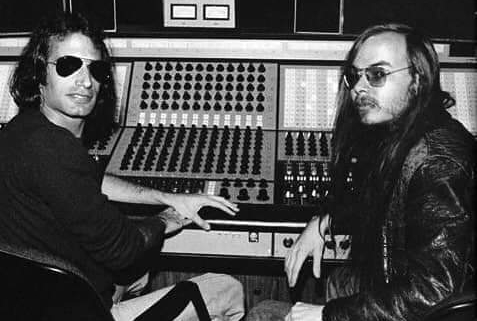
Donald Fagen and Walter Becker recording Aja
Although Fagen didn’t want to completely rewrite the Steely Dan formula for success, he did want to take a thematically different approach than the duo had over the prior decade. The Dan’s lyrics tended to be filled with irony, dark sarcasm, and tales of sad sacks and ne’er-do-wells – all heavily influenced by Becker’s nihilistic contributions to their songwriting collaborations. Fagen, however, wanted to take a more nostalgic, autobiographical direction to his first solo project – undoubtedly influenced by the fact that he was now 34 years old and reflecting on the end of a very significant portion of his life. So for The Nightfly, Fagen decided to take his audience back in time to America in the late 1950s and early 1960s, the era in which he grew up in suburban New Jersey. But despite the lyrical and thematic changes, Fagen did stick to a lot of the musical tendencies that had become hallmarks of his time in Steely Dan – the neurotic attention to detail; the countless takes with dozens of studio musicians; and the blending of the genres that most influenced the duo, including pop, rock, jazz, and R&B. And in addition to the similarities in the recording process and arrangements, Fagen brought in some of the Steely Dan studio stalwarts, like producer Gary Katz, drummer Jeff Porcaro, and guitarists Larry Carlton and Rick Derringer.
The lyrics of this record make it clear that even as a child, Fagen was able to pick up on the societal optimism and patriotism that emanated from middle-class nuclear families across the nation. And this is never more clear than on “I.G.Y.” – the abbreviation for the “International Geophysical Year,” which was a collaborative project among the world’s scientists that spanned from 1957-58. The song was by far the biggest hit of Fagen’s solo career, and on it he details the grand plans for a “streamlined world” with promises of eternal freedom and youth, transatlantic tunnels, and a space wheel that artificially creates gravity – all made possible by “fellows with compassion and vision.” “New Frontier,” which is a direct reference to JFK’s Democratic National Convention speech in 1960, tells the story of a teenage boy (who if not actually Fagen, is clearly a Fagen stand-in), who brings a girl into his family’s nuclear fallout shelter in an attempt to get laid. Fagen also brings us into the geopolitical climate of the time with “The Goodbye Look,” which focuses on a couple who needs to flee from a Caribbean island during a military upheaval. But aside from the direct references to the historical events of the era, we also get a surprisingly romantic version of Fagen, who was almost never revealed to us in the Steely Dan years. Love stories and romantic nostalgia drip from the lyrics of “Green Flower Street,” “Ruby Baby,” “Maxine,” and “Walk Between Raindrops,” but Fagen most successfully nails the theme on the album’s title track. The protagonist of “The Nightfly” is a late night jazz radio DJ, who spends the wee hours of the morning talking to crazy callers, drinking coffee, and smoking Chesterfield cigarettes, but still finds himself on the verge of tears while he reminisces about a past love.
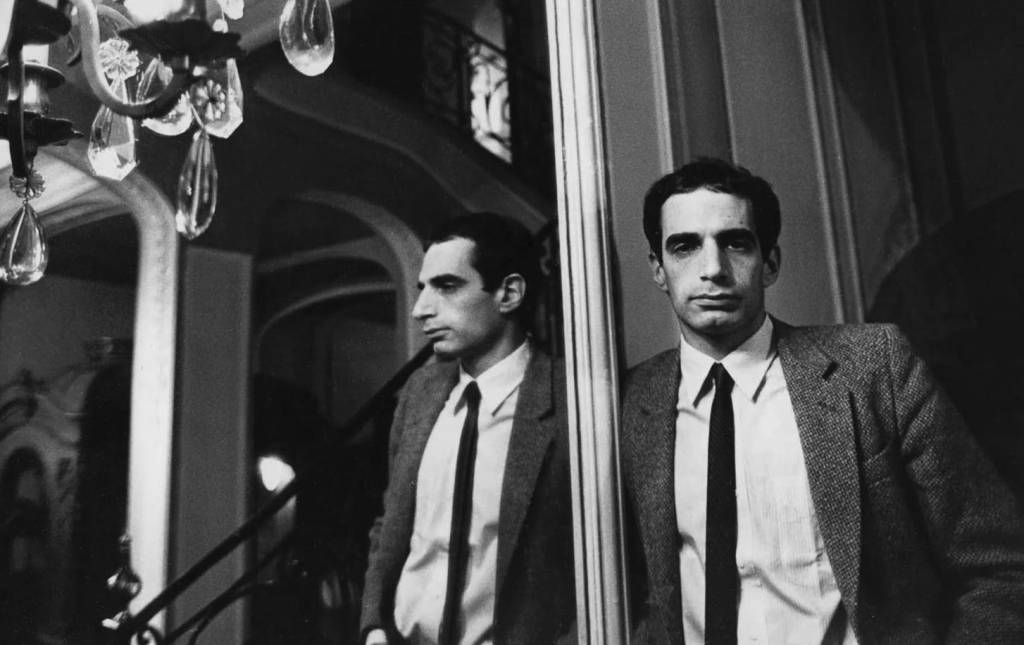
Fagen poses alongside his own reflection
Despite its many successes, The Nightfly would end up doing a number on poor Donald’s psyche. He has since said that he missed Becker’s collaboration during the writing process, and that he was emotionally broken by the pressure of not only creating his own solo work, but also spending so much time reflecting on his past. After the album was released, Fagen suffered chronic panic attacks, got on antidepressants, and completely dropped out of the public spotlight for the next decade. And aside from the impact it clearly had on him as an individual, I do think that there is something missing on this album without Becker. With that being said, what I do want to make clear is that two things can be true – this is an excellent album and a clear demonstration of Fagen’s solo ability, but I can’t help but think that it almost feels like Diet Steely Dan. While songs like “I.G.Y.,” “New Frontier,” and “The Nightfly” are as good as any in the Dan’s catalog, some of the filler songs like “Maxine” and “Ruby Baby” fall a little flat.
What I don’t think gets discussed enough is the fact that the end of the Fagen/Becker songwriting partnership is almost an identical parallel to the McCartney/Lennon break-up that happened exactly a decade prior – two musical geniuses have a near perfect run of albums over the course of a decade and then split up while they’re still at the peak of their powers. And although the Dan would reunite for two more releases in 2000 and 2003 – which are both great in their own right – it just wasn’t the same. So Steely Dan fans, much like the Beatles fans who came before them, will always be forced to reckon with the haunting question of “what if?”

 80 Albums of the 80s
Leave a reply to Swoon – Prefab Sprout (1984) – 80 Albums of the 80s Cancel reply