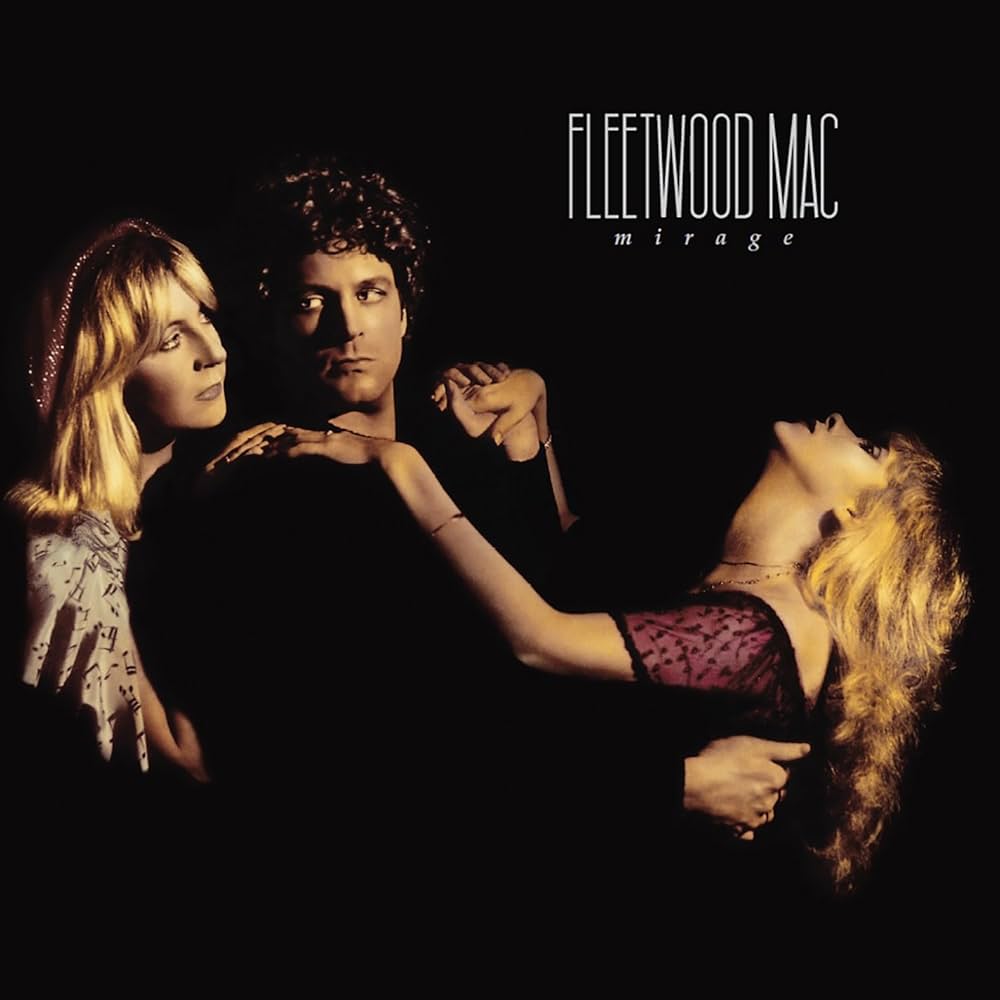
Mirage – Fleetwood Mac (1982)
April 18, 2025
Part IV of Mac Month:
A Four-Part Series on the Members of Fleetwood Mac
You can read Part I of Mac Month here, Part II here, and Part III here.
After the tumultuous recording and relative lack of commercial success for their 1979 release, Tusk, the members of Fleetwood Mac needed to go their own way (sorry, I couldn’t resist). So in 1981, Stevie Nicks would release her insanely successful Bella Donna, Lindsey Buckingham would demonstrate his commitment to maintaining Law and Order, and Mick Fleetwood would play the role of The Visitor in his journey to Ghana. But despite the fact that all three albums performed well on the charts (although Nicks clearly blew her two bandmates out of the water), none of their individual efforts quite captured the magic of their combined chemistry, and Warner Brothers was eager to get the toxic trio back in the studio along with John and Christine McVie.
As can always be expected with the Mac, the recording of Mirage was a chaotic, messy nightmare. Mick Fleetwood had pushed the band to use a studio in France, prompting a double dose of diva from Nicks and Buckingham, who complained about the food (despite having a personal chef in the studio) and the lack of television (which was remedied by co-producer Ken Caillat bringing in video machines with pre-recorded tapes of professional baseball games). And likely due to the fact that most of the members of the band had experienced personal success so recently, their tolerance for one another had all but evaporated. The director of the music video for “Hold Me” described the atmosphere as “a fucking nightmare” and said the band “couldn’t be together in the same room for very long.”

Fleetwood Mac in the studio for the recording of Tusk
But despite the horrendous vibes within the band’s dynamics, the recording sessions resulted in what can only be described as a fantastic album. After the commercial letdown of Tusk, Mick Fleetwood’s goal for the band was to make a return to form that captured the magic and pop sensibility of Rumours. Although matching their magnum opus would obviously prove to be an impossible task, they came just about as close as they could and would reach the top of the Billboard 200 for the first time in five years. And in addition to the success of the album as a whole, the Mac would land three of their singles on the pop charts with McVie’s “Hold Me” and “Love in Store” reaching #4 and #22 respectively, and Nicks’ “Gypsy” reaching #12 (Buckingham notably had no singles reach the pop charts, which I’m sure he handled extremely well).
Like with all Fleetwood Mac releases, the album thematically focuses on failed relationships and lost love, and includes some Easter eggs that reference the incestuous nature of all of the band’s members. The lyrics also touch on Nicks’ failed relationship with producer Jimmy Iovine on “Straight Back,” Christine McVie’s failed relationship with Dennis Wilson of the Beach Boys on “Only Over You,” and the recent death of Nicks’ best friend on “Gypsy.” Buckingham also makes a self-referential nod (shocker) to one of his solo songs from the prior year, making a callback to the lyrics of “That’s How We Do It in L.A.” on his second urban homage, “Empire State.”
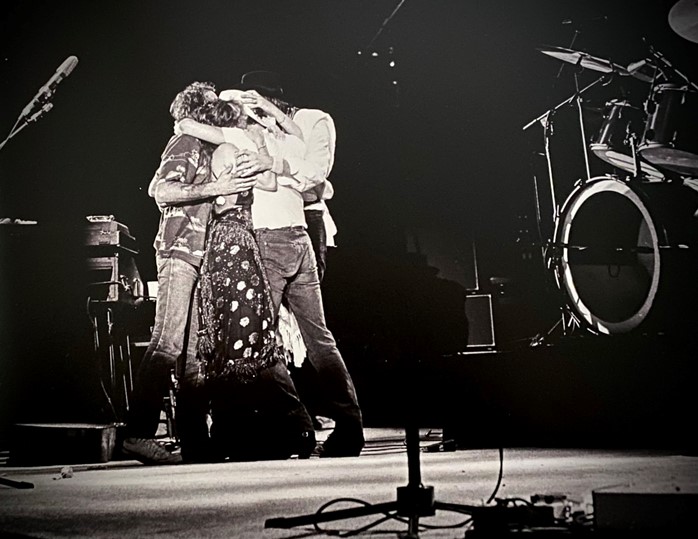
The band embraces at the end of a show on the Mirage Tour
With Mirage, Fleetwood Mac again proves that not only is their toxicity and dysfunction not an impediment to their success, but it is actually critical to it. Their in-fighting and jealousy seem to bring out the best in each other in a way that is rarely seen in other musical collectives. But where I think they have an edge is in the fact that they have three singer songwriters who are competing with one another at all times. Where other bands may have had a guitarist who was envious of the lead singer’s spotlight or a bassist who just wanted to be included, Fleetwood Mac thrives on the fact that it is a three-headed monster. Mirage perfectly blends the pop perfection of Rumours and the more avant garde nature of Tusk to produce an interesting, but accessible record that is the platonic ideal of the soft rock genre. And what’s truly stunning about just how good this album is – both Buckingham and McVie have since said that they felt less invested in and passionate about this project than they had on prior releases. Imagine half-assing something with a bunch of people you despise and still getting something this good? It’s crazy, and it’s the reason why Fleetwood Mac is one of the exceptional bands of all time. But because of the toll this album clearly took on all its members, the band would go on another hiatus immediately after its release – this time for five years. But come 1987, the Mac would prove that they had one more messy, magical moment left in the tank…

 80 Albums of the 80s
Leave a reply to Law and Order – Lindsey Buckingham (1981) – 80 Albums of the 80s Cancel reply