The Visitor – Mick Fleetwood (1981)
April 11, 2025
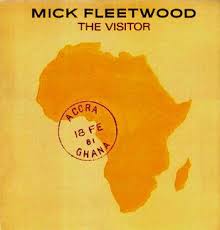
Part III of Mac Month:
A Four-Part Series on the Members of Fleetwood Mac
You can read Part I of Mac Month here, Part II here, and Part IV here.
Mick Fleetwood is a peculiar case where the namesake of one of the most popular bands of all time is the least well-known member of the group. And on top of the fact that the band was literally named after him, Fleetwood pre-dated the most recognizable members of the group, including Stevie Nicks, Lindsey Buckingham, and Christine McVie, who wouldn’t join the band until the 1970s. But back in the late ‘60s, Fleetwood, John McVie, and Peter Green would leave their prior band, John Mayall & the Bluesbreakers, to form the first iteration of Fleetwood Mac. And although the original lineup did have a few hits, including “Black Magic Woman” (which I never knew wasn’t originally a Santana song), they never quite broke through into the pop music mainstream. But after many different members came and went – most notably Bob Welch, who would go on to have a successful solo career in his own right – Fleetwood finally found his dream team and the secret formula to perfect pop songwriting with John and Christine McVie, Lindsey Buckingham, and Stevie Nicks.
But after one of the most incredible three album runs for any rock band of all time – featuring 1975’s Fleetwood Mac, 1977’s Rumours, and 1979’s Tusk – the band had reached a crossroads and needed to spend some time apart. Despite their obvious chemistry and unmatched talent, the incestuous, toxic environment and relative commercial disappointment of Tusk proved to be too much, and the group took a three year hiatus – with Nicks recording Bella Donna, Buckingham recording Law and Order, and Fleetwood recording The Visitor.
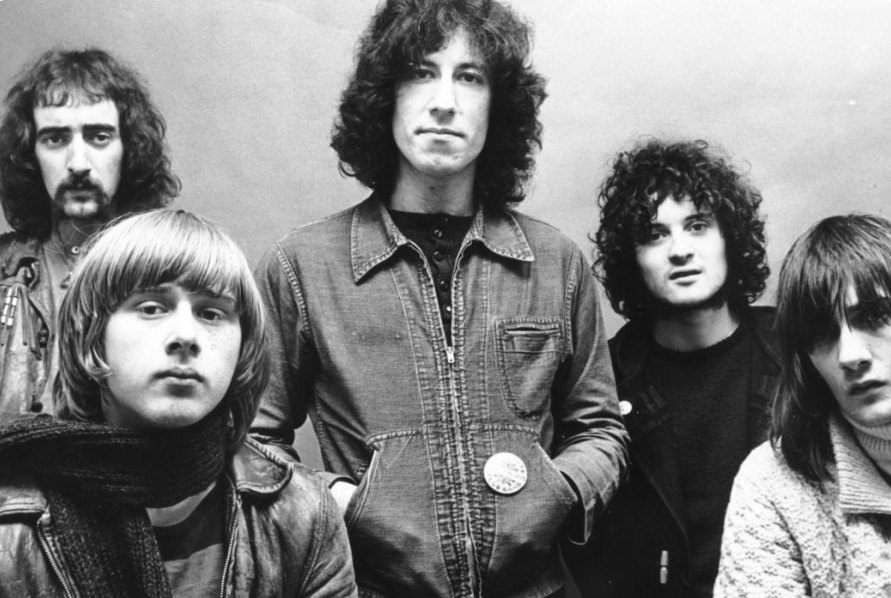
The original iteration of Fleetwood Mac: John McVie, Danny Kirwan, Peter Green, Jeremy Spencer, and Mick Fleetwood.
For The Visitor, Fleetwood decided that he would go to Ghana to collaborate with the most talented local musicians that he could find. He was also well aware of his limitations as a musician (while a solid drummer, he was no singer), as well as his lack of songwriting chops, and decided to bring in some old friends to help him out. His first call for the lead singer job was to his ex-bandmate Bob Welch (who couldn’t take the gig due to scheduling conflicts), so he instead gave the job to George Hawkins, who had been Kenny Loggins’ go-to bass player for years. And in addition to Hawkins, Fleetwood recruited another ex-bandmate in Peter Green to take on lead vocal duties for a cover of “Rattlesnake Shake,” which had appeared on Fleetwood Mac’s 1969 record, They Play On. But the biggest name Fleetwood was able to get onboard was his former brother-in-law, George Harrison, who played slide guitar and sang backing vocals on the cover of “Walk a Thin Line,” a Buckingham-penned song from Tusk.
But while the more traditional rock songs featuring Fleetwood’s old bandmates, collaborators, and friends are undeniably solid, The Visitor is at its best when it embraces the local musicians and sounds from the country it is visiting. The Adjo group makes the most significant contributions with “O’Niamali,” “Walk a Thin Line,” “Not Fade Away,” and “Amelle (Come On Show Me Your Heart)” – the last of which seems like a clear-cut influence and inspiration for Paul Simon’s Graceland, which wouldn’t be released until half a decade later. Other Ghanaian contributors on the album include Ebaali Gbiko, Lord Tiki, the Accra Roman Catholic Choir, the Superbrains group, and the Ghana Folkloric Group – all of which steal the show from their much more famous and much more heralded Western counterparts.

Fleetwood with his Ghanaian collaborators
With The Visitor, Fleetwood again proves that he is just about as good a bandleader as anyone to ever do it. While no one would ever claim that he’s the most talented musician or gifted songwriter, his superpower is being able to bring together people who possess the skills that he lacks (and often manage a lot of big egos in the process). And although Buckingham, Nicks, and McVie rightfully get the credit for being what made Fleetwood Mac so incredible – there is no band without Mick Fleetwood. Aside from the fact that he was the one to scout the talent of these incredible performers, he also had the near impossible job of managing the chaotic collective of exes and enemies to ensure that they were able to share their music with the world. And Fleetwood reaches a similar achievement on his debut solo release (which is nowhere near as chaotic and admittedly not quite as good), and combines the familiar faces from his past with another culture’s artists who hadn’t ever had the chance to share their music with Western audiences. In this sense, Fleetwood was more akin to a head coach or a general manager of a sports franchise – his job was never to make the plays himself; his job was to build a winning team. He did just that in his decades with Fleetwood Mac, and he proved it once again with The Visitor.

 80 Albums of the 80s
Leave a reply to Graceland – Paul Simon (1986) – 80 Albums of the 80s Cancel reply