Bella Donna – Stevie Nicks (1981)
March 28, 2025
Part I of Mac Month:
A Four-Part Series on the Members of Fleetwood Mac
You can read Part II of Mac Month here, Part III here, and Part IV here.
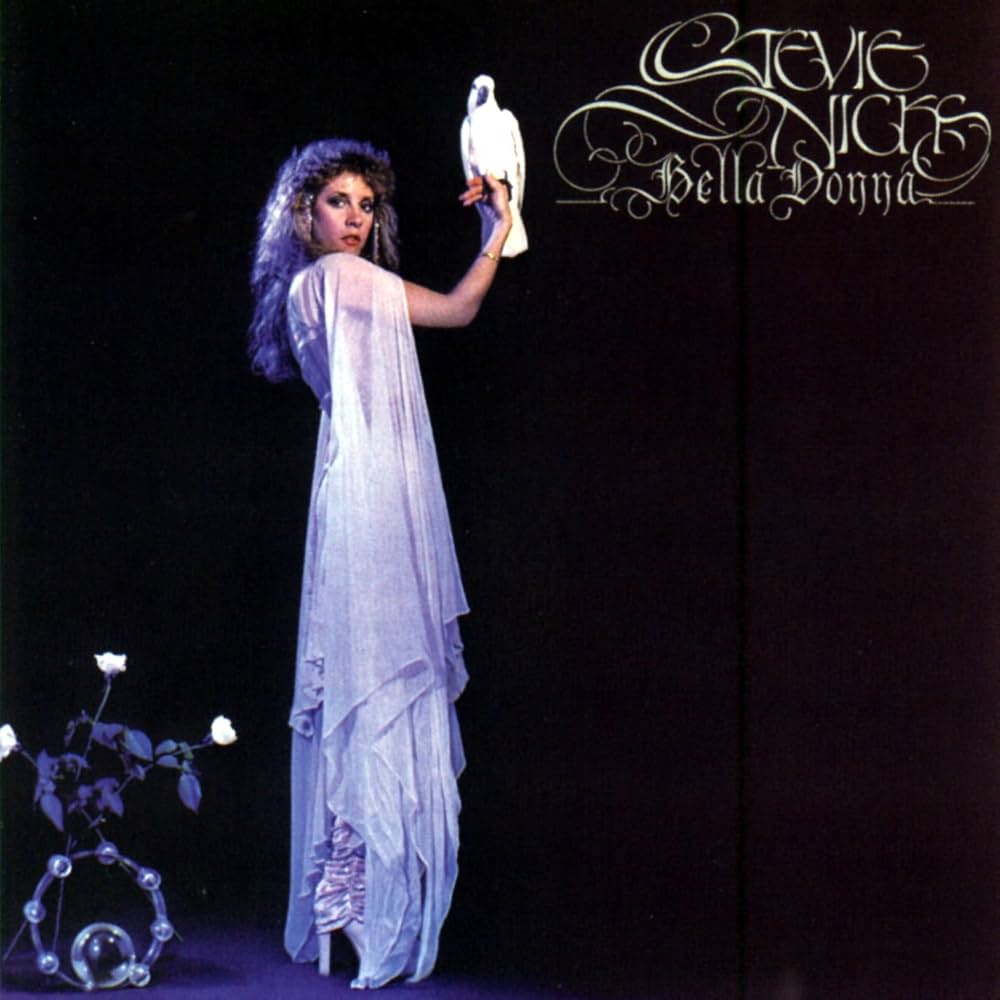
After a turbulent relationship and break-up with Lindsey Buckingham and five years with one of the great rock bands of the 1970s, Stevie Nicks was ready to go out and prove herself on her own. Fleetwood Mac had gone on one of the best three-album runs in the history of rock music with 1975’s Fleetwood Mac, 1977’s Rumours, and 1979’s Tusk – but a lot of the magic (and a lot of the praise) was rightfully credited to the fact that they were a band of five songwriters and three singers. And as is often the case with professional sports, sometimes players who are members of great teams just want to go out and prove that they can be “the guy.” Sometimes it works out; sometimes it doesn’t – but in the case of Nicks’ 1981 solo debut, Bella Donna, she definitely proved her point.
Nicks had been writing a lot of the music that would appear on Bella Donna throughout the 70s during her time with Fleetwood Mac – and in fact, she had actually written “Think About It” for Christine McVie while the band was recording Rumours. With so much material ready to record and her fellow bandmates also wanting some time away from Fleetwood Mac, it was the perfect moment for her to establish herself as a solo artist. Given that she was a non-musician and focused her attention on singing and songwriting, Nicks brought in two notable male rock stars to help fill in the void left by Buckingham. Tom Petty and Don Henley (whose illustrious résumé included being a former member of the Eagles and a former boyfriend of Nicks) not only each sang duets on the album, but also contributed to other tracks with guitar and drums, respectively. The two singers also brought along some of their Heartbreakers and Eagles bandmates to assist, providing Nicks with all the back-up she would need to make her debut album. And in one of the wiser decisions she made for the record, she acknowledged her limitations and gave her studio musicians leeway to develop their own arrangements, which would then be paired with her lyrics. So as a result of the combined forces from three of the biggest rock bands of the prior decade, Bella Donna was a smash hit – peaking at #1 and remaining on the Billboard Top 200 for nearly three consecutive years.
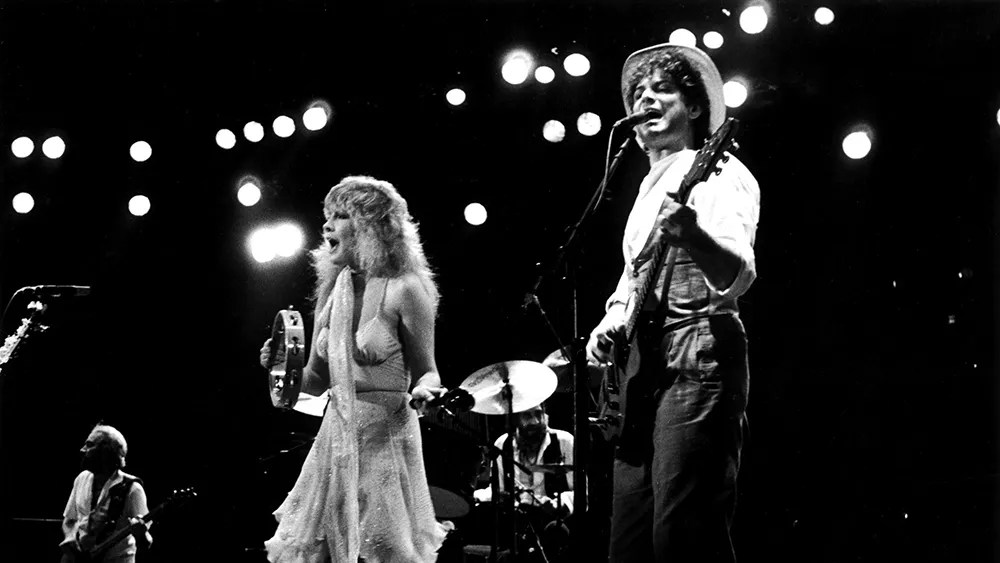
Nicks and Buckingham with Fleetwood Mac
Unsurprisingly, Nicks’ focus throughout the album is on relationships, lost love, and most notably – Lindsey Buckingham. Despite the fact that their relationship had ended half a decade earlier and they had maintained a professional working relationship (albeit an extremely dysfunctional one), it’s obvious that she couldn’t help but remain hyper-fixated on her ex. The first verse of the title track that opens the album isn’t exactly subtle – “You can ride high atop your pony. I know you won’t fall, ’cause the whole thing’s phony. You can fly swinging from your trapeze, scaring all the people, but you’ll never scare me.” She then returns to the cowboy metaphor on the album’s final track where she acknowledges that deep down she believes he is more talented and that she’s just chasing after him in vain – “And he in all his glory was far ahead of her. But she was never sorry for wishes that would burn. Enter competition she chases beneath the moon.” The clearest nod to Buckingham – and specifically their time together in Fleetwood Mac – comes in “How Still My Love,” which musically sounds quite a bit like “Dreams” and makes some pretty obvious lyrical references to both “Go Your Own Way” and “Silver Springs.”
Aside from all of the juicy Buckingham gossip, the album is definitely at its best on Nicks’ duets. She and Petty’s “Stop Draggin’ My Heart Around” is sonically reminiscent of the Heartbreakers, and the combination of their “not technically good” vocals work surprisingly well as a pairing. The connection between her and Henley is also extremely obvious on “Leather and Lace,” as the country ballad does truly feel like they are having a conversation at the end of a relationship. And the most enduring part of the album and Nicks’ legacy as a solo artist is of course on “Edge of Seventeen,” which hits particularly hard as an arena rock song in the midst of an album filled with country and soft rock ballads. Aside from the catchy guitar and memorable chorus, Nicks’ songwriting abilities are at their best on this track – capturing her emotions after her uncle died during the same week that John Lennon was assassinated. And also of note – the title actually came from Nicks hearing Petty’s wife say that she met him at the “age of seventeen” in a southern accent, and the “white winged dove” line came from something she saw on an airplane menu. Leave it to Stevie Nicks to make one of the most iconic songs of the 1980s out of mishearing something said in passing and getting inspiration from an airplane cocktail.

Petty and Nicks in the studio
Many could rightfully argue that Nicks was the least musically talented member of Fleetwood Mac, and it is factually true that she was the only non-instrumentalist in the group. But what cannot be argued is that she not only had the most successful solo career, but is also far and away the most famous member of the band. Ask a casual music fan to name a Lindsey Buckingham or Christine McVie song – they almost certainly can’t. Ask the same person for a Stevie Nicks song and they will be able to provide at least one, if not more. What that makes me wonder is – why? Is it the fact that she was a beautiful, charismatic woman with a weird witch persona? Is there something about her coke-drip, raspy voice that lends itself to rock anthems and country ballads alike? Is it the fact that her actual name is way more memorable than any stage name that somebody could ever dream up? Whatever it is – for better or for worse – Stevie Nicks is and always will be both the face of Fleetwood Mac and of all female rock singers. So despite any insecurity she might have felt about Lindsey being “ahead of her” – I think she won, and I think she won by quite a bit.

 80 Albums of the 80s
Leave a reply to The Visitor – Mick Fleetwood (1981) – 80 Albums of the 80s Cancel reply