Tom Tom Club – Tom Tom Club (1981)
January 31, 2025
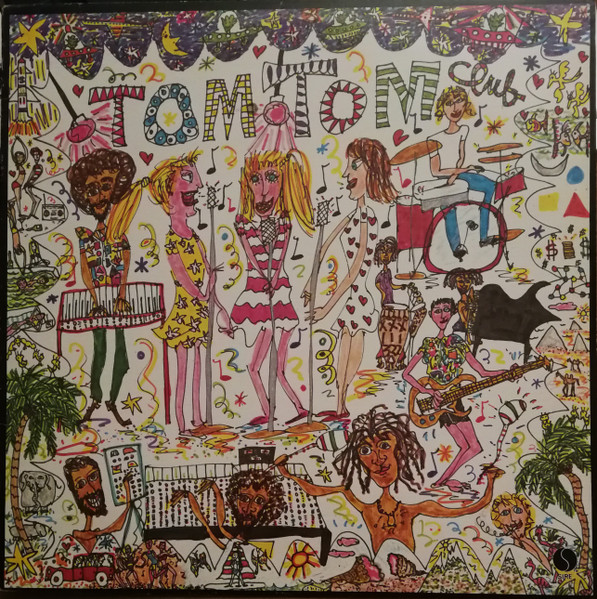
After the dysfunction that took place during the recording and release of Remain in Light, it became clear that the best move for all of the members of Talking Heads would be to take a little time apart. David Byrne went off to record My Life in the Bush of Ghosts with Brian Eno, Jerry Harrison released a solo album called The Red and the Black, and husband-wife duo Tina Weymouth and Chris Frantz formed a spin-off group called Tom Tom Club. They recruited frequent Talking Heads collaborator and touring member, Adrian Belew, along with Weymouth’s three sisters and two bona fide Jamaican reggae musicians – Tyrone Downie (formerly of Bob Marley and the Wailers) and Uzziah “Sticky” Thompson.

Talking Heads in the late 70s
It’s no secret that the music that Byrne wanted to make in the early 80s was different than what the rest of the band wanted – weirder, more experimental, and prominently featuring his name in bold letters on the cover. Weymouth and Frantz meanwhile wanted to continue the Talking Heads formula that had been working since the late 70s – experimental, but not inaccessible; pop, but not cheesy; and rock, but not “dad rock.” Tom Tom Club’s self-titled debut did exactly that, as it feels like it could very easily slide in with the rest of Talking Heads’ discography if it weren’t for the absence of Byrne’s distinct vocals. And despite missing the band’s frontman and most famous member, their debut album charted at #23 on the US charts – right in the same wheelhouse as Talking Heads’ prior two releases (Fear of Music at #21 and Remain in Light at #19).
And on top of the success of the record as a whole, their signature single, “Genius of Love,” was a massive hit – reaching #31 on the Billboard Hot 100 and #1 on the Dance Club Songs chart. In addition to charting higher than any Talking Heads original (their cover of “Take Me to the River” did reach #9), it has become one of the most sampled songs of all time. Byrne of course had to maintain his aloof, above-it-all attitude, and told Frantz at the time that he thought it was “merely commercial music.” Although Frantz has since said that Byrne did eventually recognize the success of “Genius of Love” and credits it with being one of the primary factors in getting him to continue on with Talking Heads. Of note, the song does appear in the 1984 concert film, Stop Making Sense – with Byrne off-stage (of course).
Aside from the album’s biggest hit, “Wordy Rappinghood” picks up where Blondie left off on 1980’s “Rapture” – immediately entering the early 80s white girl rap Hall of Fame. Tom Tom Club also does at least attempt to stay a bit high brow with several of the songs, including references to Greek and German mythology in “Genius of Love” and “Lorelei;” commentary on the Iranian Hostage Crisis in “Wordy Rappinghood;” and the entirely French lyrics of “L’Elephant,” which comment on the violent tendencies of mankind. But the album as a whole is extremely danceable and fun – the songs often blend into one another and lead you to realize by the end that you haven’t stopped moving the entire time that it’s been playing.

Tom Tom Club in the studio
As with many solo projects and spin-off group releases that come out after the fracturing of an iconic band, you get a clear look at who was bringing what to the table. After listening to Tom Tom Club, it’s extremely evident what Weymouth and Frantz contributed to the Heads – the fun factor. Part of what makes Talking Heads such a great band is that while exposing you to experimental sounds and world music you might never have heard otherwise, their songs are just really fun to listen to. They have a kinetic, high-energy element to them that makes them fun to dance to without being cheesy or lazily written. Of course, Byrne is the face of the band and the most innovative, talented contributor to their immaculate discography. But he’s also a dick – there’s really no other way to put it. His competitive and even mean-spirited relationship to the rest of the band wasn’t subtle – Weymouth has even gone as far as to call him “Trumpian” and point out the fact that Byrne refuses to mention any of them by name, only referring to them as “the people he used to play with.” Regardless of the drama and “what could have been” aspects, it’s hard to complain about the on-and-off nature of Talking Heads. It has led to some excellent releases that are among my favorite records, including Tom Tom Club, My Life in the Bush of Ghosts, and Byrne’s 2012 collaboration with St. Vincent – Love This Giant. But the fact remains – regardless of how good these side projects were – Talking Heads is a prime example of the whole being greater than the sum of its parts, even if each of those parts is undeniably excellent.


Leave a Reply