Guilty – Barbra Streisand (1980)
December 20, 2024
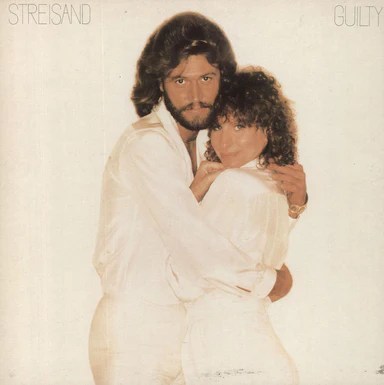
When you think about pop music in the 1970s, two of the first acts you might think of would be Barbra Streisand and the Bee Gees. Streisand had gone from primarily recording covers of musical theater and cabaret staples in the 1960s to full-blown pop icon status with her release of Stoney End in 1971, which became a top 10 album on the Billboard 200 and included three hit singles. From there on out, she would become a regular on the pop charts with multiple hits both as a solo artist and in her collaborations with other stars like Donna Summer and Neil Diamond. And by the end of decade, Streisand had not only become the most successful female musical artist in U.S. history, but trailed only Elvis Presley and the Beatles in career album sales.
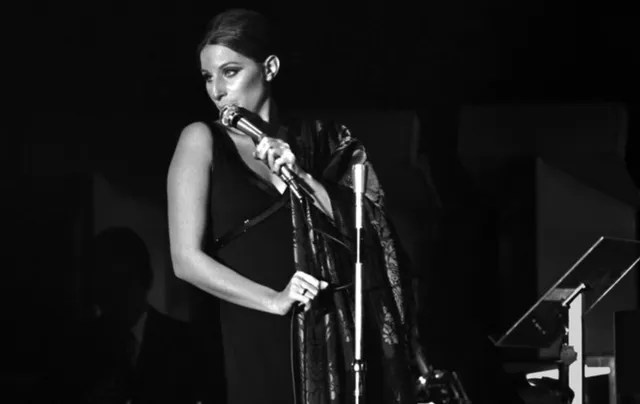
A young Streisand performing in Las Vegas
The Bee Gees, meanwhile, had finished the 70s with two absolute mega-hit releases – 1977’s Saturday Night Fever (though technically a soundtrack and not an official Bee Gees release) and 1979’s Spirits Having Flown. Aside from the fact that both albums peaked at #1 on the pop charts, the Bee Gees totaled nine #1 hit singles throughout the decade and released countless others that reached the Billboard Hot 100. And given not only the enormous popularity of their own music, but also the huge success of Saturday Night Fever as a film, disco was propelled to the forefront of pop music and the Bee Gees became the undisputed faces of the genre.
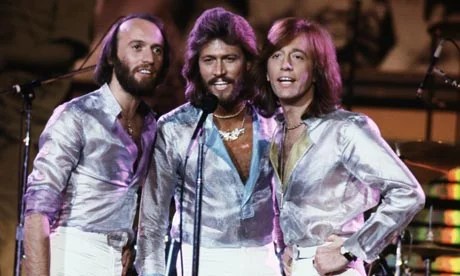
The Gibb Brothers at the peak of their powers
So after the trio’s incredible run the decade prior, frontman Barry Gibb decided to focus most of his attention on producing and songwriting. Meanwhile, Streisand was in search of songwriting talent for her next album, and decided to approach Gibb to help her with her next release. Although the original plan was for him to write half of the album, the output was so obviously working that he decided to do the entire thing. All of the album’s tracks are a combination of his own solo writing, as well as collaborations with both of his brothers (though primarily Robin) and prolific producer of the 70s, Albhy Galuten.
Unsurprisingly, given the raw talent and star power of both Streisand and Gibbs, Guilty was an enormous hit and became her best selling album to date. In addition to reaching #1 on the pop album charts, it produced four hit singles – with “Woman in Love” peaking at #1, the title track at #3, “What Kind of Fool” at #10, and “Promises” at #53. The album is definitely at it’s best on the two duets with Gibb (“Guilty” and “What Kind of Fool”), which represent the two primary types of songs included on the record. “Guilty,” “Promises,” and “Never Give Up” sound like they could’ve been Bee Gees recordings had the band had a Gibb sister included in the original lineup. On the other hand, songs like “What Kind of Fool,” “Run Wild,” “The Love Inside,” “Life Story,” and “Make It Like a Memory” are true Barbra ballads and feel like a nod to and acknowledgement of the non-disco-oriented fans of her earlier works. The two archetypes blend perfectly on “Woman in Love,” which is a pop masterpiece that is definitely in contention with “Guilty” for the album’s best song. And on top of its success at the time, the lasting influence would be demonstrated when it went on to inspire one of the most memorable hits of the 2000s, Britney Spears’ “Oops!… I Did It Again” (seriously, listen to “Woman in Love” and “Oops!… I Did It Again” back-to-back and you’ll be stunned just how similar the melodies are).
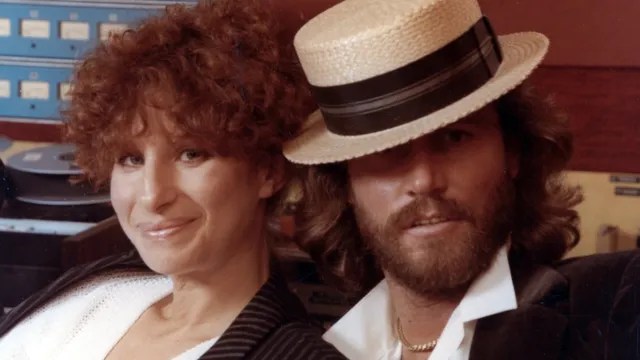
Barb and Barry – two of the GOATs of pop music
What makes this album so good – and what made it so successful at the time – is the fact that it sort of appeals to everyone on some level. It genuinely feels like an album that you could listen to with your mother and your grandmother, and all three of you would enjoy at least parts of it. The pop prowess of Gibb appealed to younger generations of disco fans, and Barb’s penchant for theatrical ballads and love songs allowed the album to reach older audiences. That’s why there is a case to be made that Guilty is the quintessential Adult Contemporary album (a term that replaced “Easy Listening” on the charts in 1979). Both terms perfectly encapsulate what it feels like to listen to this album – it can be enjoyed by a wide range of adult audiences, it feels contemporary (both in 1980 and even decades later, as proven by Britney Spears), and is nothing if not easy to listen to. The smoothness, sophistication, and sappy sincerity of Guilty are made possible by two absolute icons of the 1970s who joined forces to propel their influence on pop music into the next decade.

 80 Albums of the 80s
Leave a reply to She’s So Unusual – Cyndi Lauper (1983) – 80 Albums of the 80s Cancel reply