Doolittle – Pixies (1989)
March 6, 2026
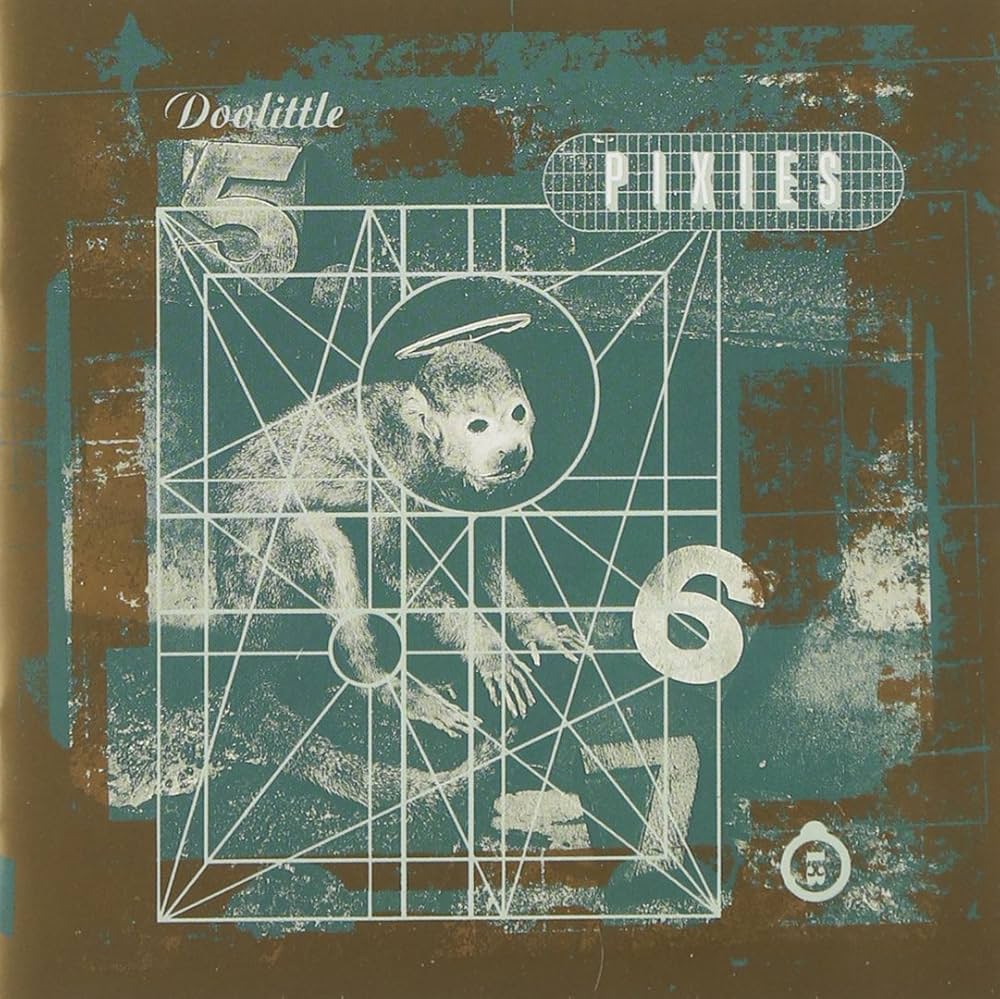
Lead singer and primary songwriter Black Francis met guitarist Joey Santiago during their time living next door to each other while attending UMass Amherst. The duo would form a band together in 1986 and recruit their newest member, Kim Deal, through an advertisement seeking a bassist who liked both Hüsker Dü and Peter, Paul and Mary (a Venn diagram that I would imagine had a very limited middle section). Upon adding David Lovering (who Deal had met at a wedding), the Pixies released their first EP (Come On Pilgrim) in 1987 and their debut full-length album (Surfer Rosa) in 1988 – and in the process, developed a decent following throughout Europe (particularly in Croatia, where their album would reach #4).
Despite not breaking through in the US, their modest early success was enough to get them signed on to Elektra Records, who ponied up $40K (quadruple the budget of Surfer Rosa) for them to record their 1989 masterpiece, Doolittle. Unlike their prior release – which had been produced by alt rock darling, Steve Albini – the direction from Elektra and their handpicked producer, Gil Norton (who had worked with China Crisis and Echo & the Bunnymen earlier in the decade), was to find a way to make a slightly more commercial sound that could find an audience in the US. So as a result, Francis’ goal was to make a series of short songs that would rarely run over three minutes in an attempt to emulate one of the great pioneers of rock & roll – Buddy Holly.

Deal, Lovering, Francis, and Santiago
Tensions within the band would run high throughout the recording process – with major creative differences between Francis and Deal, as well as arguments over the amount of guitar reverb between Santiago and Norton. But in spite of the constant conflict throughout the recording process, Doolittle would end up being propelled by a combination of heavy MTV rotation, the success of “Monkey Gone to Heaven” on college radio station airwaves, and eventually the band being selected as U2’s opener on their Zoo TV tour three years later – finally reaching its apex at #98 on the Billboard 200 and #8 on the British pop chart.
Throughout its fifteen tracks (which only amount to a 38-minute runtime), Doolittle is filled with a number of deep-cut biblical and mythological allusions, including the story of David and Bathsheba on “Dead,” the tale Samson and Delilah on “Gouge Away,” and references to Neptune (the Roman god of the sea) on both “Monkey Gone to Heaven” and “Mr. Grieves.” Francis’ lyrics also focus on a number of societal issues of the time, with “Waves of Mutilation” honing in on the real-life reports of Japanese men committing murder-suicides after failed business ventures, “I Bleed” calling out the atrocities faced by the indigenous people of the American southwest, “Here Comes Your Man” telling the story of a train-hopping vagabond, and “Monkey Gone to Heaven” tackling environmental destruction and the ever-present American conflict between science and religion. But on top of the thematic heaviness and often graphic imagery present in many of these songs – the Pixies do also include some more lighthearted tracks that poke fun at the basic college girls at UMass (“Tame”), a crazy roommate that Francis had while studying abroad in Puerto Rico (“Crackity Jones”), and a parody of 50s crooners sung in the style of Ringo Starr’s goofier Beatles moments (“La La Love You”).

Pixies on stage in the late 80s
While the Pixies’ popularity and success in their heyday wasn’t exactly record setting – their legacy lies in the fact that they would prove to be incredibly influential to the brewing grunge movement that would dominate popular music in the following decade. Artists like Kurt Cobain, PJ Harvey, and Slowdive have all credited Doolittle as being inspiring to their careers, and the Pixies’ refreshingly different sound would prove to be a monumental shift in the direction of alternative rock. As the public began to tire of the synth-heavy post-punk and new wave bands that were hallmarks of the 1980s – there was no better antidote than a grittier, more distorted genre that fit in with the societal hangover that came as a result of the sticky sweet cultural moment that preceded it. And despite the fact that the Pixies output wouldn’t prove to be all that prolific – with only two more albums being released until a reunion in 2014 (mostly as a result of creative frustration from Deal, who would go on to form the Breeders with her twin sister) – their impact on music is obvious and undeniable. Doolittle is a prime example of the beginning of the end of everything that has since become associated with the 80s – and the Pixies would prove to be fitting shepherds for all that was yet to come.
 80 Albums of the 80s
Leave a comment