Freaky Styley – Red Hot Chili Peppers (1985)
November 14, 2025
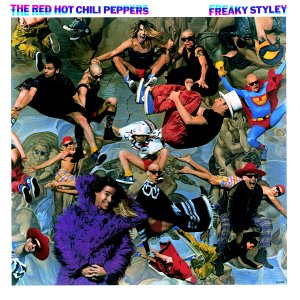
Originally calling themselves the Miraculously Majestic Masters of Mayhem – Anthony Kiedis, Flea, Hillel Slovak, and Jack Irons first met in the early 80s as high school students in Los Angeles. But Slovak and Irons were also part of a group called What Is This?, which they were prioritizing at the time, leading to a different lineup recording Red Hot Chili Peppers’ self-titled debut album in 1984. Guitarist Jack Sherman and drummer Cliff Martinez would join Kiedis and Flea for that record, and despite being a largely unknown commodity, the band would fall just outside the Billboard Top 200 (#201) – mostly due to rotation on college radio stations and MTV. Although the album performed far better than expected, the group had been largely dissatisfied with the results, as they thought the record was far too overpolished, and that producer Andy Gill (the former guitarist of Gang of Four) had pushed them too hard toward a radio-friendly sound.
So for their next release – which would include the return of Slovak on guitar – the Chili Peppers wanted to fully lean into the funk music that had inspired them from the jump. After being compared to Parliament-Funkadelic by many of their fans, they decided the only logical move would be to connect with the collective’s frontman, George Clinton. Clinton had moved on from P-Funk by the late 70s due to clashes with his bandmates and had largely focused on recording solo projects – none more successful than 1982’s Computer Games, which had charted at #40 on the US pop chart. Now also spending a good deal of his time as a producer, Clinton was fully onboard with helping the Chili Peppers lean into the funk and accepted a $25,000 payment to come on to produce their second album.

Red Hot Chili Peppers in ’85
Although the majority of the songs for Freaky Styley had already been written prior to bringing in Clinton, the quartet would join him in his Brooklyn home to put the final pieces together. But to the surprise of absolutely no one (given the drug enthusiasm of both the band and Clinton) – the writing and recording process would become a cocaine-fueled shitshow. In what Martinez would later describe as a “productive party atmosphere,” the members of the band found themselves continuously getting sick due to all the hard living that took place on their extended bender. Kiedis had originally hoped to mask his severe symptoms of heroin withdrawal by replacing his drug of choice with heavy cocaine use (spoiler alert: it didn’t work), and would end up having to abstain from coke for the two weeks he was recording to avoid any negative effects on his vocal cords. And in one of the more emblematic episodes of the whole affair – Clinton had to offer his coke dealer a spoken word intro for “Yertle the Turtle,” due to the fact that he had accrued a heavy tab that he was in absolutely no financial position to pay back any time soon. But despite the hard drugs and the chronic illnesses going on during the writing and recording process, the Chili Peppers would end up creating an excellent second record that felt much truer to who they were and more in line with what their biggest fans would enjoy.
As one might expect out of a crew of coke-snorting, mid-twenties fuckboys, the lyrics throughout the album are about as explicit as any record I can think of. “Blackeyed Blonde” tells the story of a hot girl the band met in New Orleans; “Catholic School Girls Rule” is a true story about Kiedis having a short-lived sexual relationship with a 14-year-old girl that he had met backstage at a show; and “Sex Rap” sort of speaks for itself, doesn’t it? But in addition to some of the hornier recordings on the album, the band shows that they do actually think with their big heads from time to time, as “American Ghost Dance” focuses on the genocide of American indigenous people; “Battle Ship” references the USS New Jersey, which had been deployed to the coast of Beirut during the American response to the Lebanese Civil War in 1983; and “Nevermind” takes shots at some of the Chili Peppers’ musical contemporaries, including the Gap Band, Zapp, Wham!, Duran Duran, Soft Cell, Men at Work, Hall & Oates, and Culture Club. And although the band shows their disdain for a lot of the decade’s biggest acts, they pay homage to some of their favorite artists with covers of Sly & the Family Stone’s “If You Want Me to Stay,” the Meters’ “Africa” (although they wisely updated the title to “Hollywood” to make it a bit truer to them), and even a musical version of Dr. Seuss’ Yertle the Turtle.

Flea, George Clinton, and Anthony Kiedis
Freaky Styley is a monument to a very young, very raw version of the phenomenon that would become the Red Hot Chili Peppers we know today. And even though this record was essentially dead on arrival from a commercial perspective – which Flea would aptly blame on the fact that it was “too funky for white radio, too punk rockin’ for black” – it in many ways shows them in their truest form. Aside from any pearl clutching that may have taken place around the admittedly grotesque and misogynistic lyrics, there is absolutely no denying the talent and the magic of the Chili Peppers on this record. And in addition to their own abilities as musicians and songwriters, there was absolutely nobody on Earth who could have produced a record like this other than the great George Clinton. But despite the fact that this album would not even sniff the charts, it set the wheels in motion for the band’s final two releases of the 80s – which would reach #148 and #52 respectively – and eventually lead to their sudden leap into global superstardom with their 1991 masterpiece, Blood Sugar Sex Magik. Regardless of the fact that their best days were most certainly in the 90s and early aughts, the Red Hot Chili Peppers of today would not exist without their 1980s building blocks – and Freaky Styley remains an early example of all the longevity and acclaim they would achieve over the decades that followed.
 80 Albums of the 80s
Leave a comment