Born in the U.S.A. – Bruce Springsteen (1984)
August 22, 2025
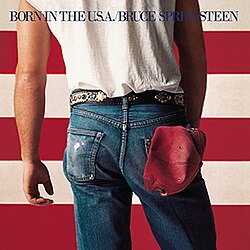
From the mid-70s through the early 80s, Bruce Springsteen had established himself as one of the preeminent American rock artists. His last four records – Born to Run (1975), Darkness on the Edge of Town (1978), The River (1980), and Nebraska (1982) – had all reached the top 5 on the Billboard 200, and his next release would catapult him to a whole different level of pop superstardom. But before that would happen, Bruce became inspired to talk to Vietnam War veterans who were living in Los Angeles to try to learn more about them and hear about their often difficult lives and experiences. These conversations would heavily impact Springsteen’s songwriting for the next several years and lead to the inclusion of “Highway Patrolman” on his lo-fi, acoustic album, Nebraska; the crafting of the theme for Paul Schrader’s 1987 film, Light of Day; and most notably – a lion’s share of the tracks on his 1984 mega-hit, Born in the U.S.A.
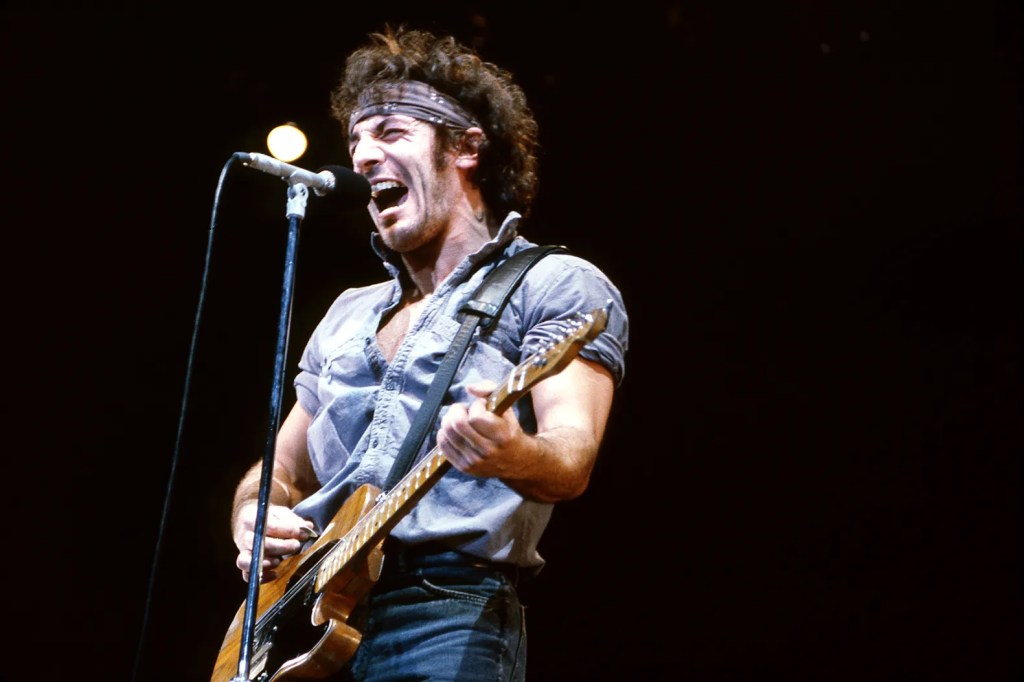
Bruce on stage in the 80s
In contrast to his prior release, Bruce took the exact opposite approach with Born in the U.S.A. by including heavy doses of synthesizers in a highly produced tracklist. This would also be his first record after the departure of his childhood friend and E Street Band stalwart, Steven Van Zandt – who despite leaving the group, did still contribute as a guitarist and the album’s co-producer. And on top of the notable changes in production and personnel, Springsteen also made some adjustments to his lifestyle, like beginning therapy and starting a weight-training regimen that would have a notable (and much criticized by “sellout” accusers) impact on his appearance. These choices – despite some regrets that Bruce would have later on – would pay off, and result in not only the biggest success of his career, but one of the signature releases of the entire decade. The album would shoot to #1 on the Billboard 200 and light up the pop singles chart with seven top 10 hits, including “Dancing in the Dark” peaking at #2 (which remains the biggest hit of his career), “Glory Days” hitting #5, “I’m on Fire” and “My Hometown” both landing at #6, “Cover Me” making it to #7, and both “I’m Goin’ Down” and the title track reaching #9.
Despite the synth-infused, radio friendly nature of the album’s tracklist, Bruce maintains his brooding, contemplative lyricism that focuses on themes like the struggles of the working class, relationship issues, and the inherent (but often conflicted) patriotism of the American people. He also includes his signature blue collar “Bruce characters,” who appear to fill in for his own feelings and experiences in the sad (but often ultimately triumphant) narratives that he shares with his audience. The title track – despite being frequently misunderstood and co-opted as a celebration of the United States and cultural masculinity by many listeners (most notably by President Ronald Reagan in a 1984 campaign speech) – relays the poor treatment that so many Vietnam veterans had experienced in the years after the war. And Bruce continues the theme of the struggles of Vietnam veterans on the very next track, “Cover Me,” where a former soldier’s relationship is impacted by his PTSD. The record also includes a heavy share of songs about both romances and friendships – “Downbound Train,” “I’m Goin’ Down,” and “I’m on Fire” tackle failed relationships and infidelity; while “No Surrender” and “Bobby Jean” were penned as tributes to his friend and former bandmate, Steven Van Zandt. But Springsteen also clearly looks within himself in addition to the outside world on several songs – with a reflection on his childhood nostalgia on “My Hometown,” what he realizes will be his own future emotional reckoning in the final verse of “Glory Days,” and his desire to try to reinvent himself to get out of a rut on “Dancing in the Dark” (which is a very telling look at what he was thinking with the release of this very record).
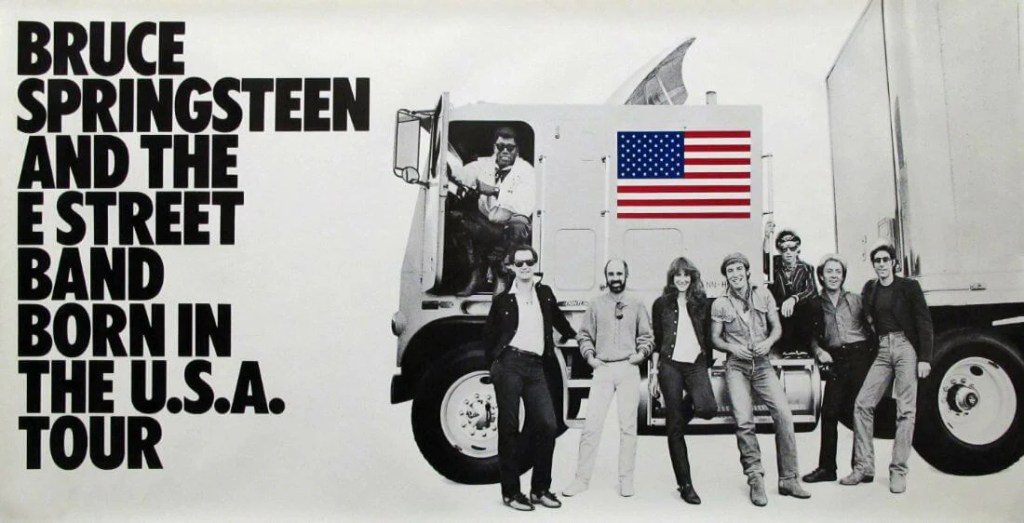
Promotional poster for the Born in the U.S.A. Tour
Born in the U.S.A. remains the most controversial piece of the legacy of one of the great American artists. Despite its incredible commercial success and cultural impact, Bruce himself has said that he still has reservations on the way it launched him to global superstardom and changed the trajectory of the rest of his career. It also became a very polarizing record to his earliest fans, who felt betrayed by the newly buff Springsteen putting a photo of his ass on the album cover and writing pop songs that they didn’t feel measured up to the grittiness of his earlier works. But the reality is that this record is undeniably excellent, even if it isn’t his finest release (a distinction that can only be credibly awarded to either Born to Run or Darkness on the Edge of Town). It is also a prime example of the “prisoner of the moment” issue of condemning pop music right after its release, as it can often be difficult to truly appreciate something when being suffocated by radio air time, ambushed by music videos, and surrounded by a full-scale marketing blitz. But more so than any album of this year, Born in the U.S.A. is the perfect encapsulation of the way that 1984 in America looked, sounded, and felt – a complicated and misunderstood piece of art representing a complicated and misunderstood period of American history.

 80 Albums of the 80s
Leave a comment